Leonardo Williams
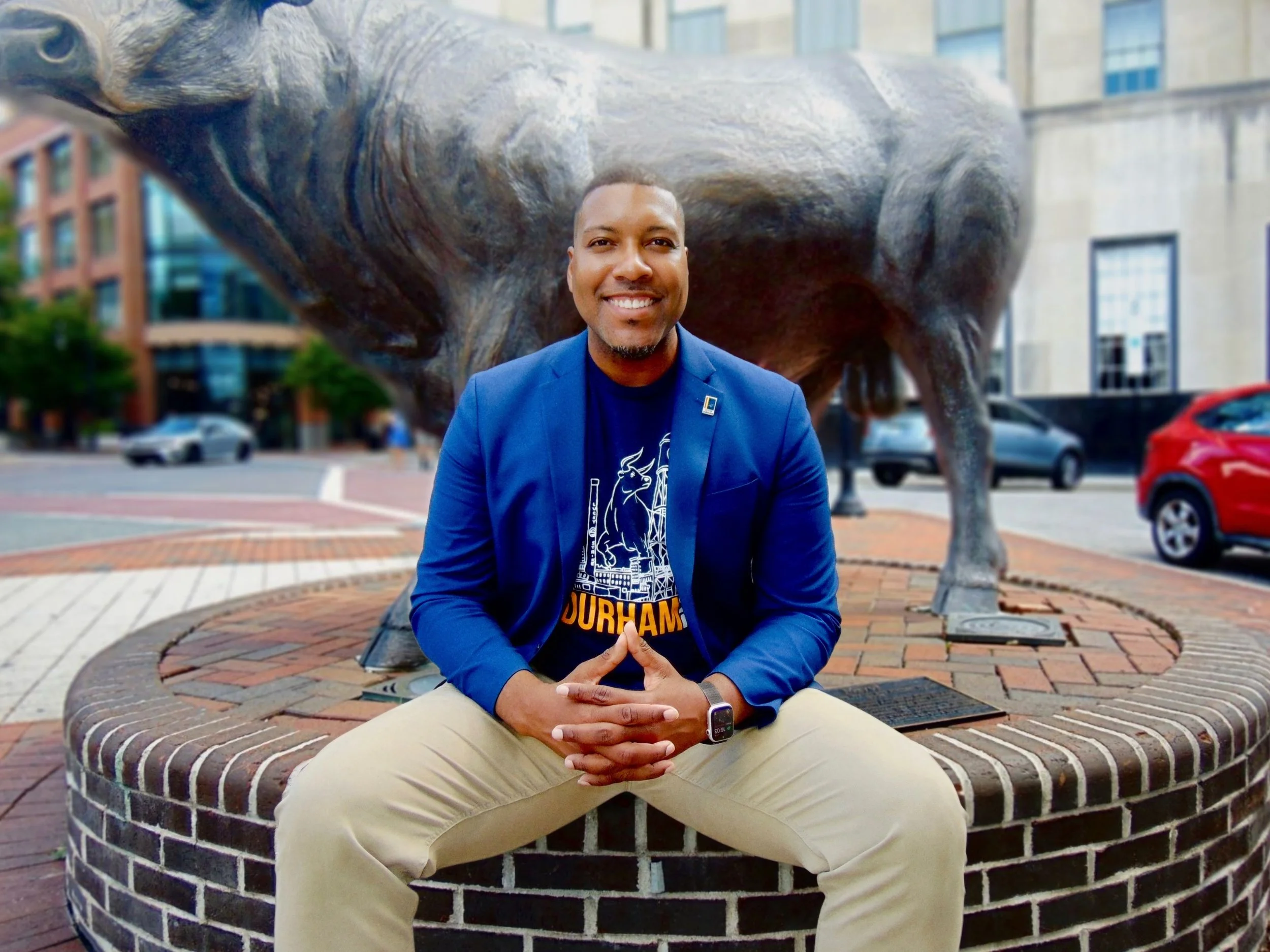
Photo by Sunny Grant
Bull City, the mayor is talking, and he’s not exactly sticking to the script! With affordable housing on the rise and plenty happening around our beloved town, we thought it was time to check in with Mayor Leonardo Williams and find out what’s really on his mind. Turns out, the man had plenty to say, and we’re glad he did. So read, react, raise an eyebrow, agree, disagree, and leave your questions for the mayor in the comments. Who knows, he might just answer.
Mayor Williams, what’s one thing about Durham that surprised you the most after becoming mayor, something residents would never expect? Give us the tea.
I’d say I was most surprised by the overwhelming innovation and creativity being born right here in the Bull City.
There’s a tale of two Durhams that I hope to make whole into a single experience one day: those who are politically engaged and those who are just focused on results. There’s cross-pollination here for sure, but if we were truly to hone in on a collective and supportive spirit of public policy backing the things that are working well already, Durham would advance even more.
Some residents say Durham feels like it’s growing around them instead of with them. What’s your response to people who feel they’re getting priced out of the city they helped build?
If we live in this city, we are this city. Part of this sensation is a combined set of symptoms that we either can control or cannot control. Either way, they are a reflection of who we are as a mixture: from wealthy to poor, engaged to disengaged, informed to misinformed.
The reality is, there are several policies that can rectify some of this at the local level. However, the housing crisis we’re experiencing locally is actually a nationwide phenomenon. That doesn’t negate our ability to do what’s right here in Durham.
We need housing of every type at every income level. When you hear someone use a snapshot, point-in-time perspective to make a claim for more or less housing, it is one of the most dangerously misleading contributions to someone feeling the pressures of high cost of living. Supply and demand is not an oversimplification; it’s the necessary basis and starting point for understanding what we can actually do via policy to ensure Durhamites aren’t faced with the choice of staying or leaving.
We are, in fact, a growing city; a much better position to be in than those experiencing population decline. Population decline is what causes your basic services to start reducing or retreating. A growing city affords us the tax base to pay for all of the things we also advocate for, including our public services.
Government at the local level does not print money like the federal government. We’re more like a jigsaw puzzle of limited resources. Durhamites should have safe, affordable living. When we stop at just affordable housing, it becomes too easy to only afford the bed you’re sleeping in.
Quality of life matters, and that is why I fought to make sure buses stayed fare-free for at least another year. I work hard to increase our housing inventory and expand programs that explore new housing types such as ADUs. It’s why I worked with every leader in the city and county to launch the largest effort to reduce crime in the city’s history.
My goal as Mayor is to communicate what is necessary and what is nice to have—and how we actually get to obtain those things.
Duke is Durham’s largest private employer and arguably its most influential institution. If you could ask Duke to do one thing differently for the city tomorrow, what would it be?
Duke employs 47,000 people, 80% of whom live in Durham, having a $2 billion economic impact on our local economy. They inject millions into nonprofits and small businesses annually. They are our most impactful strategic partner as we mutually share data that affords a more competitive posture for federal funding opportunities in transportation and research initiatives.
With all of this, I simply wish they would promote this more.
That being said, they just launched “Home Grown.” This initiative tells the story of their planned impact for the City of Durham and our region. I’m looking forward to having Durham benefit from these investments.
Some residents argue Duke’s growth puts more pressure on Durham’s housing market. Should the university be doing more to help address affordability beyond its campus?
Absolutely they should, and that’s why I’m glad they have already committed to that.
One thing I’ve learned as Mayor is that honey attracts bees better than vinegar. It became very clear to me, early in my political tenure, that Duke was better off as a partner than an enemy.
The framing of this question is really about how large employers impact our housing market, although Duke is only named. We have to stop assessing our whole community with partiality. Employers bring jobs and opportunities; mostly, they employ our people with jobs that allow them to not only take care of their affairs but invest back into our local economy.
Is there more employers can do to ensure their wages are supportive of their workforce in this local economy? Always. However, we cannot ignore the overwhelming positive impact for the bias of preferential angling.
Duke in particular is an academic institution, not a philanthropic distribution center. Much of the interest around Duke as a strategic partner must have room for managing expectations if, and only if, we want the outcomes we want.
Be it housing or any other resource, the demand for them is more than valid. However, a demand without a realistic strategy to obtain them is just political theatre.
I applaud the progress we’ve made and will continue to push for more investments directly toward housing, small business support, nonprofit sustainability, worker wages, and safe working conditions.
Downtown seems to open a new cocktail bar every other week, but residents also worry about shootings, break-ins, and smashed storefronts. Are we investing in nightlife faster than we’re investing in public safety?
To be clear, Durham is open for business. That means we have entrepreneurs—risk-takers—taking a chance on Durham almost every month with a new venture.
It is, in fact, up to the government to invest in community safety, which includes public safety. Unfortunately, how we define keeping people safe in Durham lacks a consistent meaning.
We have heavily invested in practices that will have long-term, more compassionate impacts. Unfortunately, the more short-term, acute response mechanisms have been repealed or unsupported by the majority of the Durham City Council.
We are investing aggressively in homeless reduction but have yet to provide a response to some of the organizations who are contributing to putting people out on the streets of Durham.
Our resources should:
Prevent homelessness; and
Reduce the number of people experiencing homelessness to the point of being rare and brief.
Our resources should not be exhausted by bad behavior or practices by organizations who prey on the struggle that someone is experiencing for their own agenda. This is actually happening in Durham but would require action by state-level leaders to help us at the local level reduce this harm.
New York Governor Kathy Hochul recently backed a pause on new data centers in parts of New York while officials study their impact on power, water, and communities. Durham is seeing growing interest from tech companies and AI infrastructure. Would you support a temporary pause or stricter rules before large-scale data centers expand here, or is the economic upside worth the tradeoff?
There is never an economic upside when our tradeoff is catastrophic. Durham is landlocked and we do not have enough available acreage for large-scale data centers.
As a matter of fact, Durham was the first or one of the first large cities in the state to file a moratorium on large-scale data centers. While placing this moratorium, we carved out specific types that would not restrict or harm the functionality of our education, medical, or financial companies already housed in Durham.
I believe we took the most practical approach to this while prioritizing our values simultaneously.
What’s one decision you’ve made as mayor that you knew would make people angry but you still believe was the right call?
I remember it as if it was last night. The ceasefire resolution vote.
There was surmountable pressure to vote for the ceasefire resolution. Not because of the advocacy that showed up at City Hall, but because I, too, wanted a ceasefire in Gaza, even with limited understanding at the time of the long-term conflicts in the Middle East.
I was criticized for not knowing more about the conflicts in the Middle East. Yet, my reservations continued to call on me to question: “What are we doing here? How are we prioritizing international affairs over local needs? What made this international conflict more important than the Ukraine/Russia conflict or all of the genocides happening in Africa?
“How was it that activists felt so compelled to shut down City Hall twice, but not say a damn word when there was a string of shootings that killed several children in Durham at the time?
“How was it that I was expected to ‘choose a side’ when people were dying on both sides, but most of all, here in our own streets?”
Our community was broken on that issue, and while I agreed with a ceasefire as well, I chose for my vote to represent the status of our community: broken.
Prior to my vote, I convened four rabbis, four Christian pastors, four activists, and four imams. I invited two members of the City Council to join me and asked Durham CAN’s Brianna Van Veltzen to facilitate a conversation that would help me pen a statement that embraced every perspective.
This is how I chose to lead in such a turbulent time. I made no one happy. I was demonized for my vote, but my character was intact, and that is when voices in Durham who had felt unseen and unheard began to speak up.
The following day, I received a simple note from a mother who lost her child to gun violence in Durham. The note read: “I know your job is tough because I’ve been watching. Thank you for seeing someone like me. You did the right thing.”
If you could have every Duke freshman spend one day anywhere in Durham, where would you send them and why?
I’d send them to Parrish Street, Bennett Place, the Pauli Murray Center, the American Tobacco Campus, our universities, and of course our food scene.
If they went to Zweli’s Ekhaya, I would probably be their server.
Can we do something about those ear-splitting gas-powered leaf blowers?
Ohhhhh, the gas-powered leaf blowers. Everyone hates them but the folks who use them. But to answer your question, there’s not much to be done beyond the noise ordinances we have in place.
Trump is famously fond of golf courses. If he visited Durham, would you be more worried about what he’d try to build, what he’d try to rename, or what he’d try to bury on the back nine?
No, this is the Bull City. He’s not building shit here.
Talking about renaming, local artist Jim Lee would really like to see Five Points Plaza renamed Baba Chuck Davis Plaza. What do you think?
I love that idea. It’s been brought to me before. Just have to make it happen. There’s a process that has to take place, which also takes a bit of time. I’ve already started it.
Having fun reading our interviews? Please consider contributing any sum at our Cash App: $LetsTalkDurham